Feb 13, 2026
Stop Prompting, Start Directing: Meet Prologue Intent
For years, working with generative AI has meant one thing: prompting.
Describe the lighting.
Specify the camera.
Guess the syntax.
Hope the model interprets it correctly.
But creators don’t think in syntax. They think in scenes. In rhythm. In tension. In performance. In color. In mood.
Today, we are solving this translation problem with Prologue Intent. Powered by groundbreaking multimodal capabilities, Prologue Intent analyzes reference media and extracts measurable attributes—color palette, lighting profile, pacing, composition patterns, texture density, audio energy. It converts these into structured creative attributes and maps them to model-specific parameters optimized for each model in your workflow.
Credits: Jason Zada using Kling 3.0
The Translation Gap
There’s a structural mismatch between how humans create and how models execute.
Humans think in:
- Emotional beats
- Visual references
- Tone and pacing
- Subtext
- Performance
Models require:
- Explicit camera framing
- Structured timing
- Technical parameters
- Clear spatial instructions
- Model-specific formatting
Bridging that gap manually is fragile and inefficient. That's where Prologue Intent operates.
Prologue Intent removes this manual layer. It reads the media directly, extracts structured signals, and applies them consistently across models.
From Intent to Execution
Prologue Intent doesn’t just enhance prompts. It builds a translation pipeline.
Human emotional intent → structured cinematic instructions → model-optimized prompt
Here’s what that means in practice.
1. You provide raw creative material An image, a script, a voice note, a reference video, or even a rough idea.
2. Prologue analyzes underlying intent Tone. Structure. Framing. Emotional progression. Narrative tension.
3. It extracts performance logic Where the beat shifts. Where hesitation occurs. Where emphasis builds. What the subtext implies visually.
4. It converts that into structured direction • Camera placement • Shot scale • Timing markers • Gesture choreography • Dialogue overlap • Sound design cues
5. It outputs a model-optimized prompt Formatted specifically for the target model. Not generic text. Not guesswork. Production-ready instruction.
The result is not “better prompting.” It’s directed generation.
Credits: Simon Meyer, Kling 3.0 model
Why This Matters
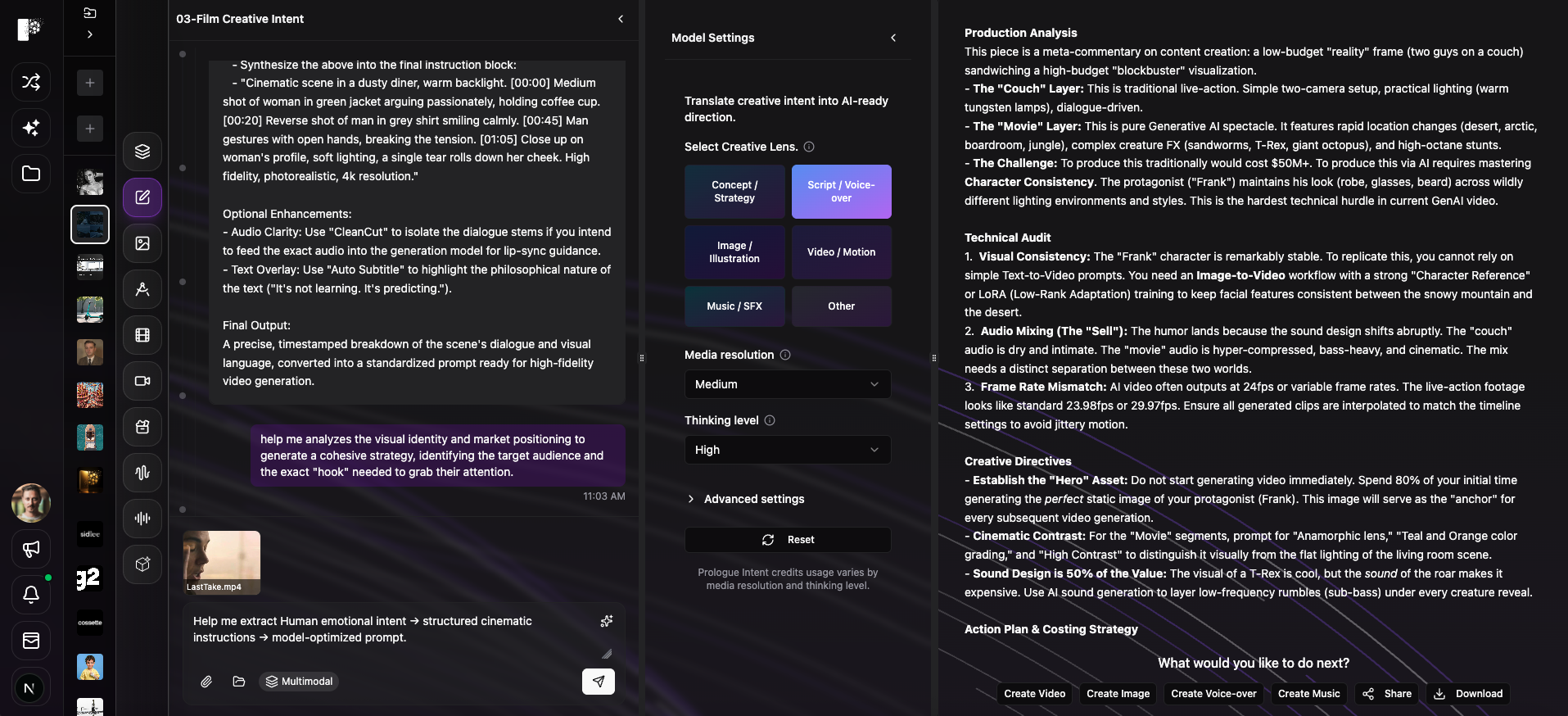
Prologue Intent activates task-specific creative engines trained for defined production stages. By selecting a specific intent mode, you activate a dedicated multimodal workflow:
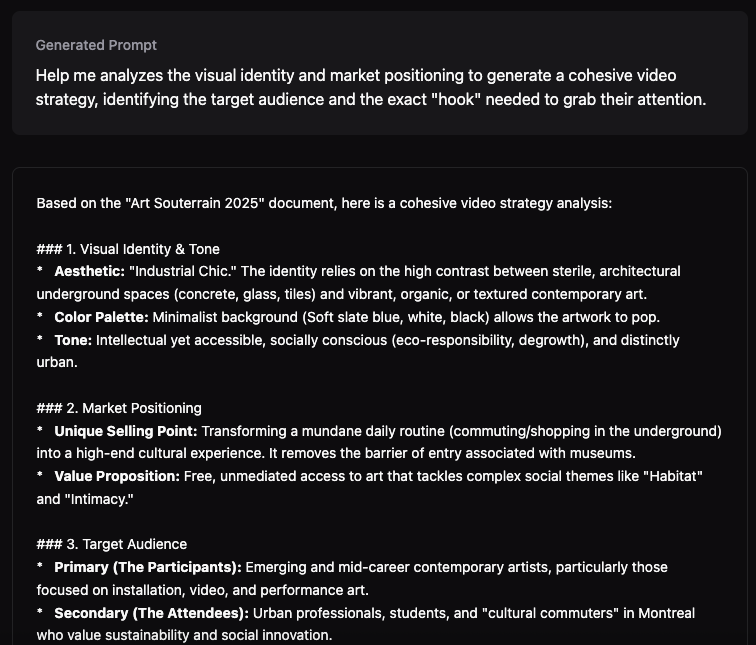
Concept & Strategy — From Vague Idea to Concrete Vision
Upload a brand PDF and a few competitor videos. Prologue Intent analyzes the visual identity and market positioning to generate a cohesive video strategy, identifying the target audience and the exact "hook" needed to grab their attention.
Script & Voice-over — From Rough Notes to Timed Narration
Upload a voice memo and your B-roll footage. The engine listens to your pacing and watches your clips, writing a script that is perfectly timed to the visual cuts, ensuring your voice-over never runs longer than your video.
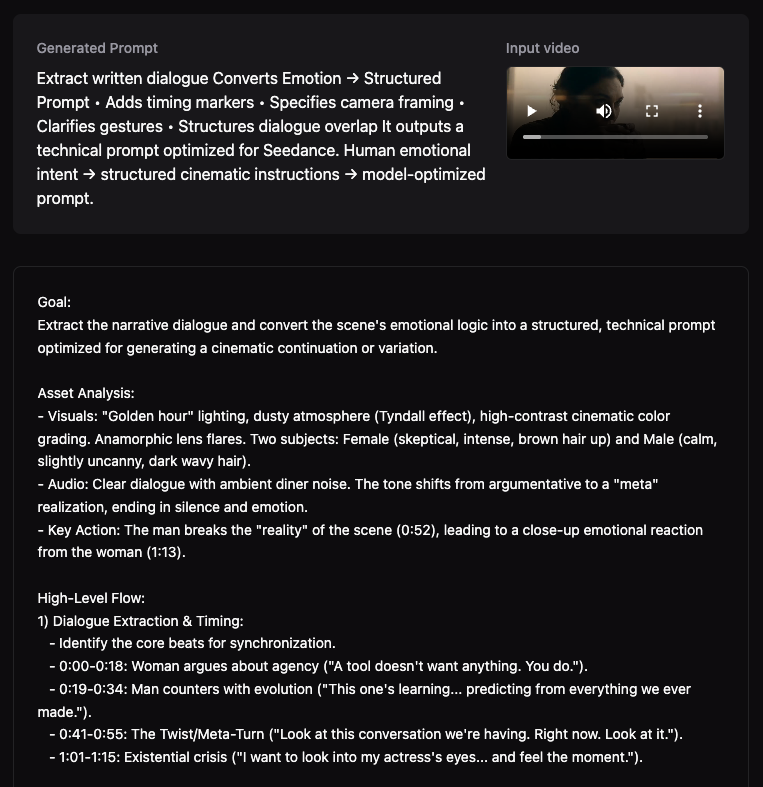
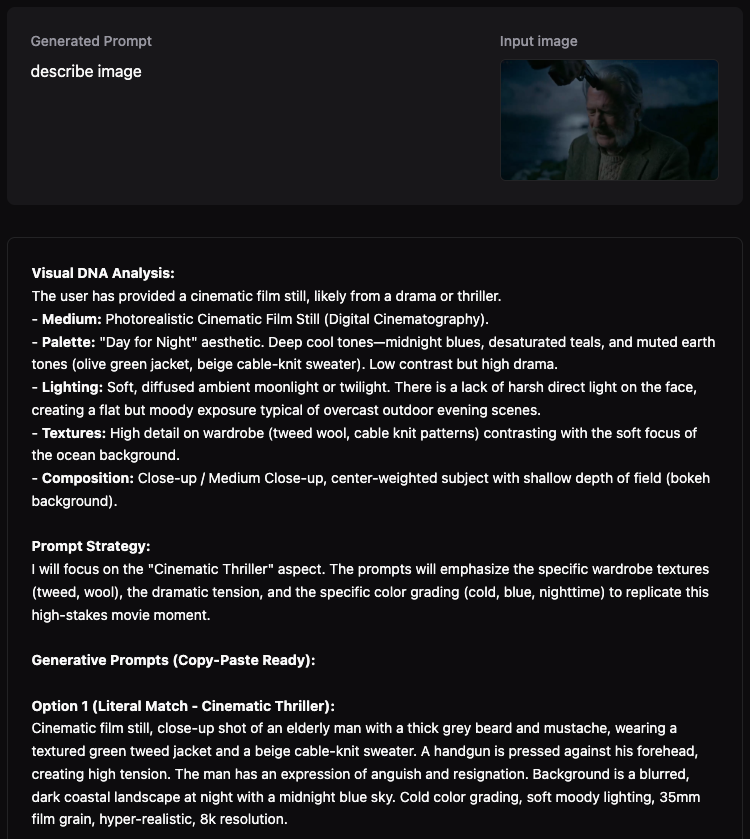
Image & Illustration — From Mood Board to Visual DNA
Upload a reference photo with a specific lighting style. Prologue Intent isolates the technical "DNA"—the lens type, the film grain, the color palette—and generates high-fidelity prompts to recreate that exact aesthetic for entirely new subjects.
Video & Motion — From Static Shots to Cinematic Action
Take a still image and describe a movement. The AI acts as your cinematographer, translating "make it move" into technical camera directions—dolly zooms, pans, or rack focus—to turn static assets into dynamic video scenes.
Music & SFX — From Silent Footage to Immersive Sound
Upload a video clip without sound. Prologue Intent "watches" the action—spotting footsteps, rain, or traffic—and generates a layered audio prompt that dictates the ambient noise, specific Foley effects, and musical mood to match the visual energy.
Multimodal by Design
Creative intent rarely lives in one format.
A single idea might include:
• A reference image
• A script draft
• A tone reference
• A soundtrack
• A performance style
Prologue Intent analyzes them simultaneously.It identifies shared intent across modalities and synthesizes them into a coherent execution plan. Not separate prompts. One unified direction.
Credits: Jason Zada using Kling 3.0
The Shift
The industry is moving from:
"Write better prompts.” To “Structure better direction.”Prompting is an interface layer. Intent is a production layer.
If generative AI is becoming part of professional creative workflows, it must behave like one.
Clear roles.
Defined pipelines.
Controlled outputs.
Stop Prompting, Start Directing
Stop fighting with the prompt box and start directing the vision. Prologue Intent translates how you think into how AI executes.
 Prologue AI Team