Sep 2, 2026
Protecting Digital Identity in the Age of AI
A face is not just an asset.
A voice is not a preset.
Yet AI tools can now reproduce, modify, and animate both with increasing realism, speed, and scale.
Our industry has spent a lot of time asking what AI can create. We have not spent enough time asking what it has the right to create.
That is the problem Prologue Consent is designed to address.
LE MONDE CHANGE — authorized synthetic performance for Barreau du Québec
Consent cannot be a release buried in a folder
In a traditional production, permission to use someone's likeness is usually negotiated before the shoot and documented in a contract. Synthetic production works differently.
A face can be generated repeatedly. A voice can be recorded, cloned, or transformed. A script can change. A performance can be re-edited, reformatted, and adapted across multiple platforms. Every new version can change what a person appears to say, do, or endorse.
A broad authorization signed at the beginning of a project may not accurately represent everything that happens throughout an AI production. Consent needs to travel with the content.
It should answer a few straightforward questions:
- Who gave permission?
- What exactly did they authorize?
- Which voice can be used?
- Which script was approved?
- Which version of the content was accepted?
- Where and for how long can it be distributed?
- What changes require a new approval?
Prologue Consent turns those questions into concrete production steps.
Making consent part of the creative workflow
Prologue Consent was not designed to slow production down. It was designed to remove ambiguity.
The process connects a person's verified identity, permissions, and approvals to the specific project in which their likeness or voice is being used.
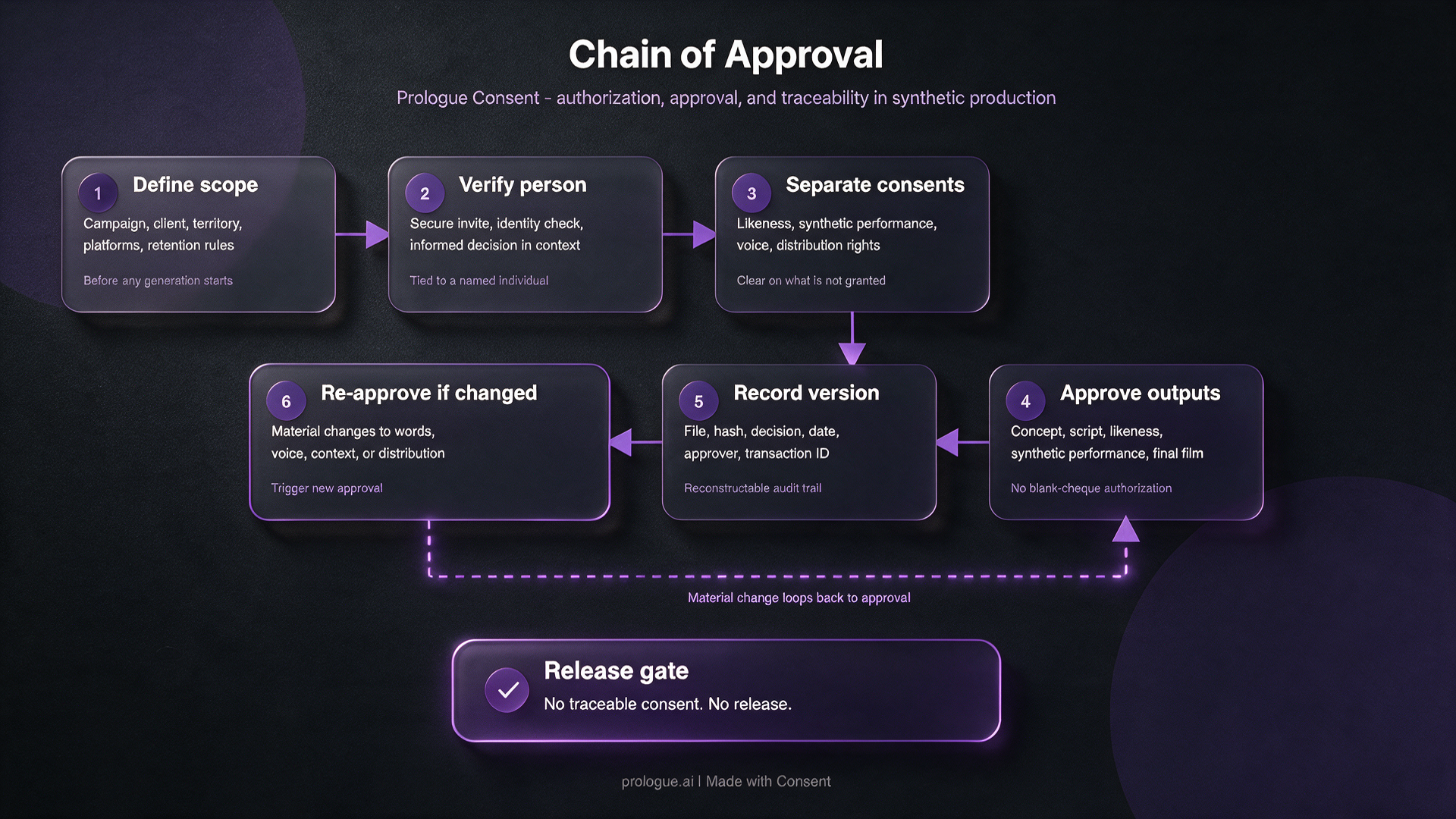
1. Define the intended use before generating
Establish the project scope — campaign, client, concept, territory, platforms, distribution period, technology providers, and retention rules — so permission for one film does not become a blanket authorization to use someone's identity anywhere else.
2. Verify the person's identity
The person receives a secure invitation, verifies their identity, reviews materials, and decides within a process tied to the production — not just an email address or file shared without context.
3. Separate different types of consent
Permission to use a photograph does not automatically include permission to create a synthetic performance. Prologue Consent can distinguish likeness use, synthetic performance, recorded voice, synthetic voice reproduction, biometric processing, and distribution rights — so people understand what they are authorizing and what they are not.
4. Approve what will actually be produced
Consent should not be a blank cheque. The person can review and approve the concept, storyboard, script, generated likenesses, synthetic performances, use of face and voice, and final film — especially important for actors, creators, spokespeople, executives, athletes, and public figures.
5. Connect every decision to a specific version
Prologue Consent can record the version presented, file name, digital fingerprint when available, decision, date and time, approver identity, and transaction identifier — reconstructing a clear authorization trail, not collecting data for its own sake.
6. Request a new approval when something material changes
A format conversion or faithful subtitles may not change the performance. A change to words, voice, appearance, context, brand, or distribution scope can. When a change is material, it should trigger a new approval.
No traceable consent. No release.
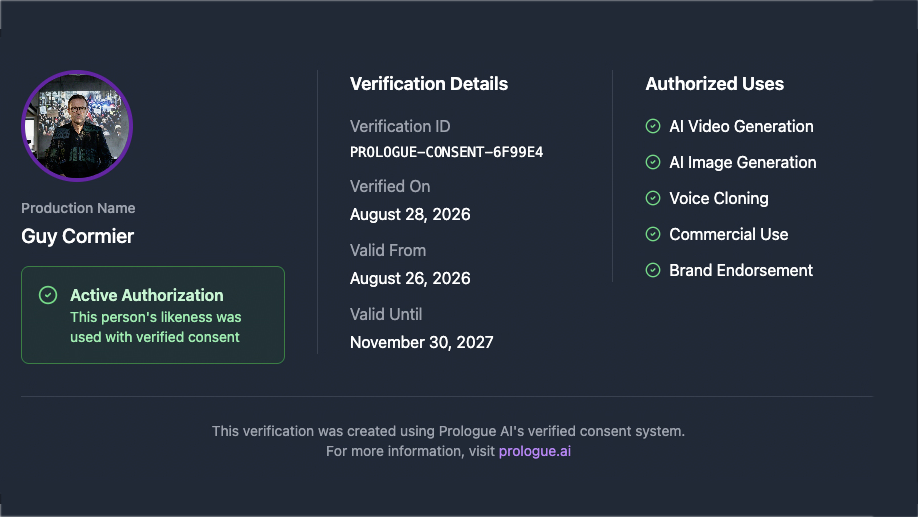
Guy Cormier — likeness, recorded and synthetic voices, and final performance handled through separate authorization steps
The first project
We applied this process to LE MONDE CHANGE, a film created for the Barreau du Québec featuring an authorized synthetic performance of Guy Cormier. His face looks credible. So does his voice. But the performance is synthetic.
The deepfake is not used simply to deceive the audience. It is used to make people feel how difficult it has become to distinguish what is real from what is generated.
The project was completed in three days. That speed did not come from removing safeguards — it came from clear responsibilities, permissions, and approval points. Consent did not slow the production down. It made the production possible.
What this changes for the creative industries
For agencies and studios, Prologue Consent creates a clearer approval path between client, production team, and person represented. For brands, it reduces the risk of unclear permissions. For producers, it clarifies what can be generated, modified, approved, and delivered.
For actors, creators, athletes, executives, and public figures, it provides the ability to remain in control of their identity. Authorizing one campaign does not mean authorizing every campaign. Approving one script does not mean approving every possible line. Authorizing one synthetic performance does not mean giving away your face forever.
Protecting people without preventing creation
We will not stop deepfakes by pretending the technology does not exist. We need systems that distinguish authorized synthetic media from impersonation.
Prologue's Acceptable Use Policy already prohibits impersonating real people or creating deepfakes without clear disclosure and the lawful right to do so. Our Privacy Policy states that customer prompts, uploads, and generated outputs are not used to train or fine-tune AI models. Prologue Consent extends those principles into daily creative work — operational, visible, and traceable throughout production.
Trust should be demonstrable
Artificial intelligence changes images. It does not change the rules of consent. In a world where any face can become a performance and any voice can deliver a new sentence, trust must be supported by a process that can be verified.
The performance may be synthetic. The consent must be real.
Are you preparing a campaign that uses the likeness or synthetic voice of an actor, creator, executive, athlete, or public figure?
Talk to our team about integrating Prologue Consent into your production workflow.